Rilke 2.0
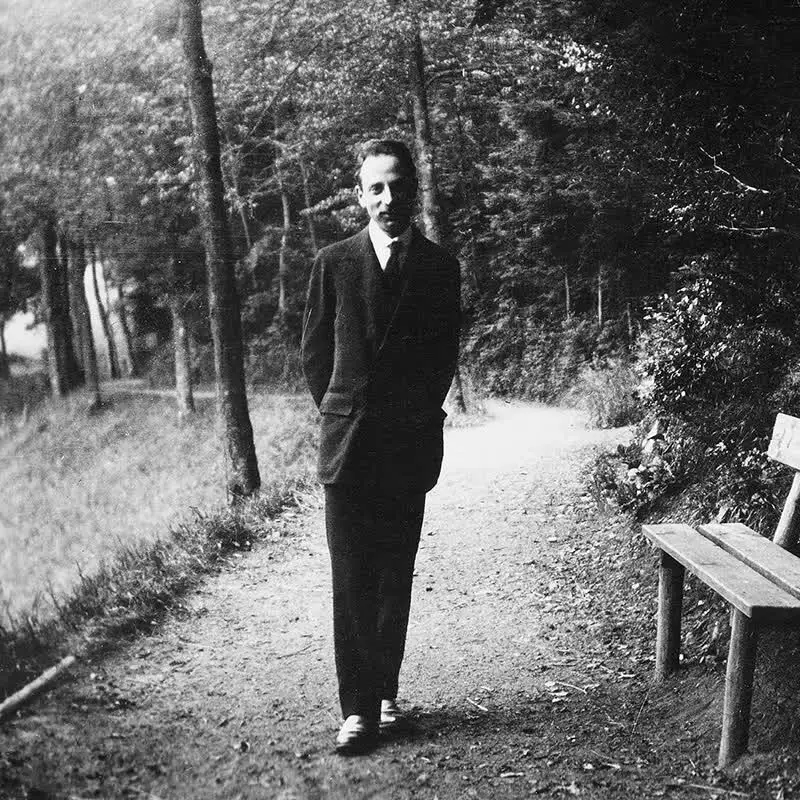
Few people have been as driven by the search for the right place as Rainer Maria Rilke. His belief that his life’s work could only be realized in the place that suited him best led him, in the final years of his life, to Switzerland and across the country. From Château de Muzot, located above Sierre in Valais, where he settled in 1921, he undertook numerous expeditions and journeys. In December 1922, he wrote to Ilse Jahr from there: “Wer weiß, wer ich bin? ich wandle und wandle mich.” (“Who knows who I am? I walk on and I change.”)
Change—in the sense of both movement and transformation—evokes a principle of life that, in today’s turbulent world, connects us more than ever to the great lyric poet. His keen perception oscillates between beauty, decline, impermanence, and grandeur. He explores the explosive power of poetry, which offers no ready-made answers to the experience of everyday life and transience, or to the existential questions of becoming and disappearance, but which finds for them an expression that has lost none of its significance to this day.
Rilke draws connections between external and internal conditions. The descriptions of landscapes in his extensive correspondence have become famous, as have his references to landscape in his poetry. Without a doubt, our current understanding of landscape is influenced by Rilke. Places such as Soglio, Winterthur, Berg am Irchel, Locarno, Muralto, Minusio, Ascona, Sierre, Muzot, and Rarogne bear his mark. Places and landscapes become a universe. As a traveler who was fundamentally not a tourist, Rilke broadens our vision of space, the city, and the landscape—of vast expanses and of confinement.
On the other hand, his influence on contemporary music, literature, and the aesthetic perception of the landscape remains undiminished. Rilke’s poems pose a challenge: “You must change your life.” Encountering beauty inspires us to act with care. But can poetry change the world and change us? How do the composers and writers of our time draw on the inspiration provided by Rilke?
For more information: